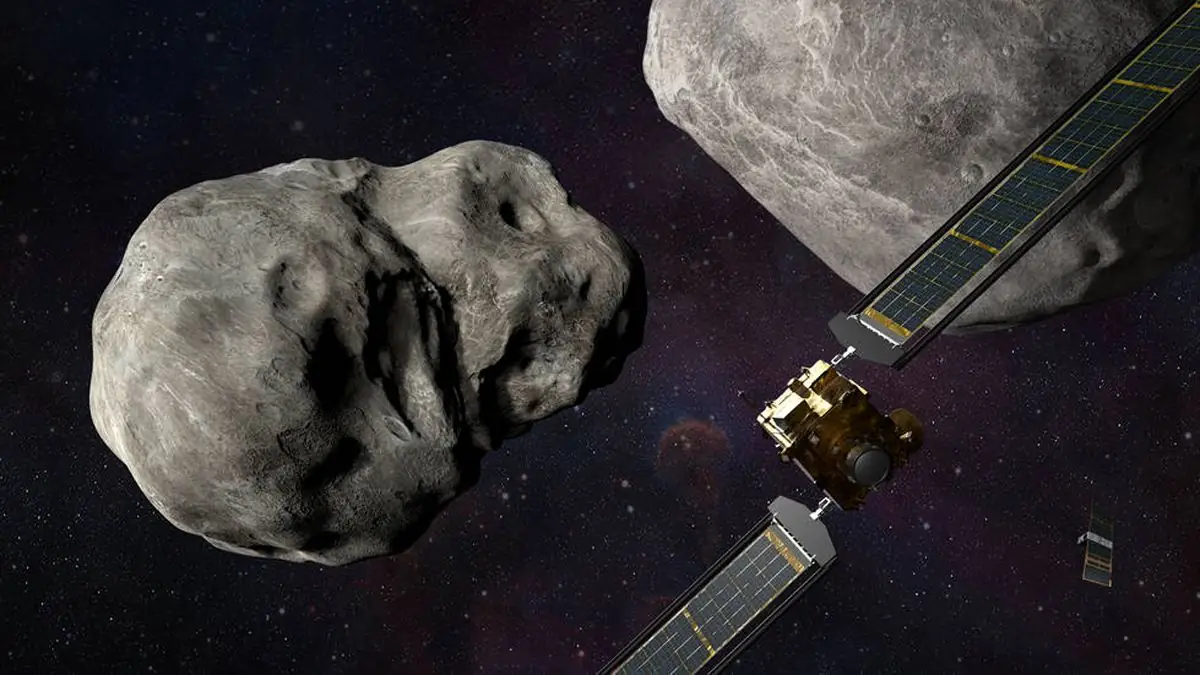
NASA's asteroid-smashing DART spacecraft hit so hard, it changed its target space rocks' orbit around the sun
NASA's asteroid-busting DART spacecraft hit with so much force that it changed the orbit of its target space rocks around the sun. "Over time, such a small change in an asteroid's motion can make the difference between a dangerous object hitting our planet or not." Breaking space news, the latest updates on rocket launches, skywatching events and more! You are now subscribed Your newsletter subscription was successful Do you want to add more newsletters? In 2022, NASA's Double Asteroid Redirection Test (DART) mission deliberately crashed into the asteroid Dimorphos, which orbits a larger asteroid called Didymos. Now, scientists have confirmed that DART not only altered Dimorphos' orbit around its binary companion, but also altered the orbit of the entire binary system around the sun. "The change in the orbital velocity of the binary system was approximately 11.7 microns per second, or 1.7 inches per hour," Rahil Makadia of the University of Illinois Urbana-Champaign said in a statement. "Over time, such a small change in an asteroid's motion can make the difference between a dangerous object hitting our planet or not." The goal of DART was to see if a kinetic impactor (in this case, the DART spacecraft) could deflect an asteroid and demonstrate that if an asteroid of similar size was on a collision course with Earth, we could move it out of its path. Article continues below The Didymos-Dimorphos double asteroid system was a safe place to practice this. Didymos is the largest asteroid, about 850 meters (2,788 feet) wide, and the smallest asteroid, Dimorphos, 170 meters (560 feet) orbits Didymos. Because astronomers had previously measured Dimorphos' orbital period and radius precisely, any deviation caused by the impact would also be easy to measure. Additionally, because Dimorphos is gravitationally bound to Didymos, the DART impact could not inadvertently launch it toward Earth. The DART impact took place on September 26, 2022, and the spacecraft impacted at 4 miles (6.6 kilometers) per second. It hit Dimorphos enough that its orbital period around Didymos was shortened from 11 hours and 55 minutes to 11 hours and 23 minutes. Before impact, the goal was to nudge Dimorphos in such a way that its orbital period was reduced by a minimum of just 73 seconds, meaning the mission was a tremendous success. A new analysis of the data, led by Makadia and Steve Chesley of NASA's Jet Propulsion Laboratory (JPL), has shown that DART's effort to push Dimorphos was aided by the cloud of debris, called ejecta, that sprayed into space while carving out a new crater. As this ejecta cloud moved away from Dimorphos, it also carried momentum. And since momentum is always conserved, this gave Dimorphos an extra boost. Scientists call this extra boost the "boost enhancement factor," and in the case of Dimorphos and the DART impact, the boost enhancement factor had a value of two. This means that the loss of the ejecta doubled the thrust imparted to Dimorphos by the initial DART impact. Breaking space news, the latest updates on rocket launches, skywatching events and more! Because Dimorphos and Didymos are connected by the invisible bonds of gravity, this extra push knocked Dimorphos and Didymos out of their orbit around the Sun, changing their orbital period by 0.15 seconds. This may not seem like much, but as Makadia alludes, it would be enough to move a dangerous asteroid away from Earth (provided it is discovered in time). To this end, NASA intends to launch a new space telescope called Near-Earth Object (NEO) Surveyor sometime after September 2027. NEO Surveyor's mission will be to find as many remaining undiscovered asteroids near Earth's orbital path as possible. Determining the change in the orbit of Didymos and Dimorphos around