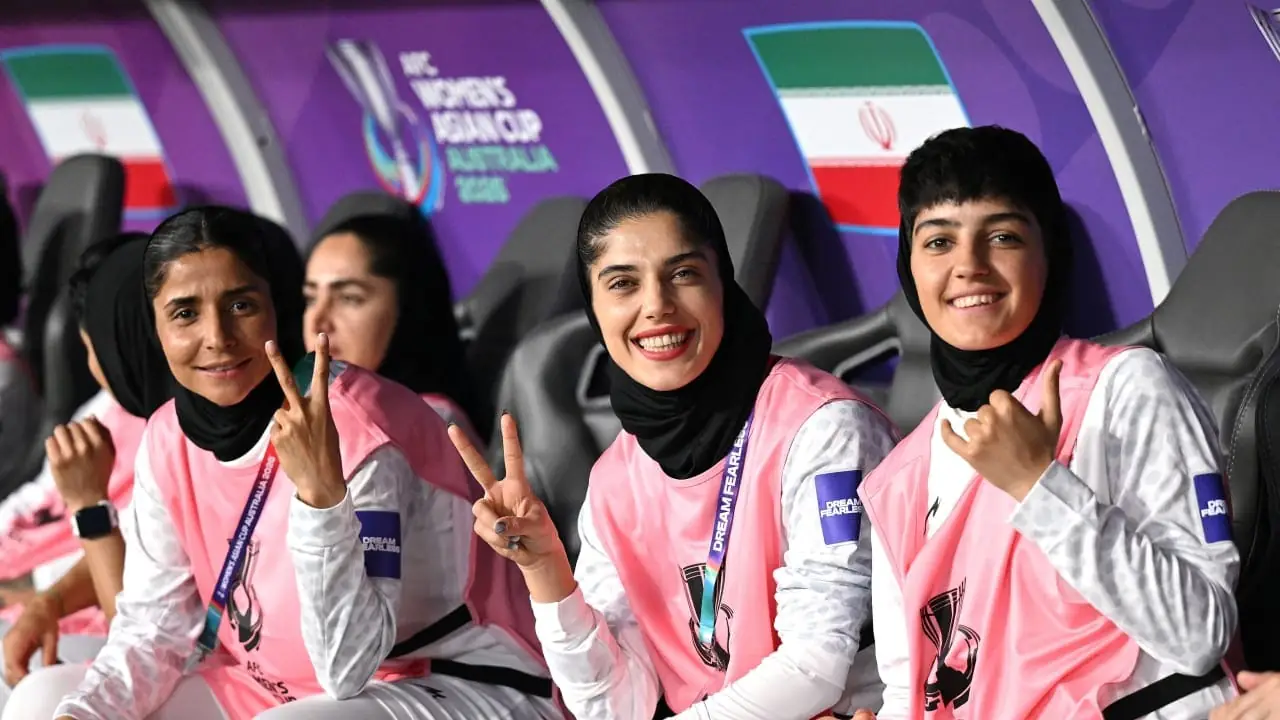
Australia grants asylum to five Iranian female athletes
Five members of the Iranian women's football team, who visited Australia to play in the Women's Asian Cup, were granted permission to remain in the country on Tuesday after international concerns arose over their safety. An inside source told CNN that two more people, a player and a staff member, had also decided to stay in Australia, although officials have not yet confirmed this. Last Monday, the players were filmed standing silently during the national anthem, an action considered treason by hardliners in Iran. The women were reportedly forced to sing the anthem during the next two matches and perform the military salute, but were filmed singing "Help" as they were sent off after their 2-0 loss to the Philippines last week. Australian Home Affairs Minister Tony Burke, who agreed to provide visas to the women, told reporters that the other members of the team were also welcome to stay in Australia, noting that the starting five players wanted to stay. Australian officials identified the players as Zahra Sarbali Alishah, Mona Hamoudi, Zahra Ghanbari, Fatemeh Pasandideh and Atefeh Ramezanizadeh. They were staying at an undisclosed location under police protection, authorities said. Simon Leske, co-founder and director of Kindra Migration Lawyers, told The Jerusalem Post that Burke had used his unique powers to grant visas to the women and that the players had likely received the subclass 449 temporary humanitarian visa. “I think from my experience it's probably subclass 449, humanitarian stay, temporary visa, which is a visa that can be used by the minister in very exceptional circumstances where a very quick grant is needed to allow a person to stay and then it would allow the minister to grant a permanent visa, and that might take a little bit longer,” Leske explained. "Now, this is a one-off intervention by the minister. Typically, an individual in Australia who was afraid to return to their country of nationality, to their country of origin, because they fear facing harm from their government or another group or individual in their country, would actually make a visa application known as a protection visa, which is subclass 866." Many Australians campaigned tirelessly for women. While she could not comment on the diplomatic implications of the move, Leske shared that many Australians campaigned tirelessly for women, including members of Australia's own Iranian diaspora community. "The fact that the minister has traveled to Brisbane to meet with the players is a fairly exceptional situation. I think it is probably due to pressure within the community to show their support," he explained. Leske noted that this is not the first time a sports team has sought asylum in Australia, pointing to the 2021 decision to grant emergency humanitarian visas to more than 20 members of the Afghanistan women's cricket team after the Taliban returned to power and banned women's sport. Australian Prime Minister Anthony Albanese confirmed that his country had also offered to help the other players on the Iranian team, but that it was his decision to accept or not. Craig Foster, former captain of the Australian men's soccer team and prominent human rights advocate, told BBC News that the situation may not simply be a matter of accepting help. "Some may have concerns, some may not, but what we know is that most of them have families at home, some have children at home, and even if they are offered the right to remain in Australia if they feel unsafe, many of them may not take up that opportunity," Foster said. "Australians have been moved by the plight of these brave women," Albanese said at a news conference in Canberra on Tuesday, a day after he was detained by police.